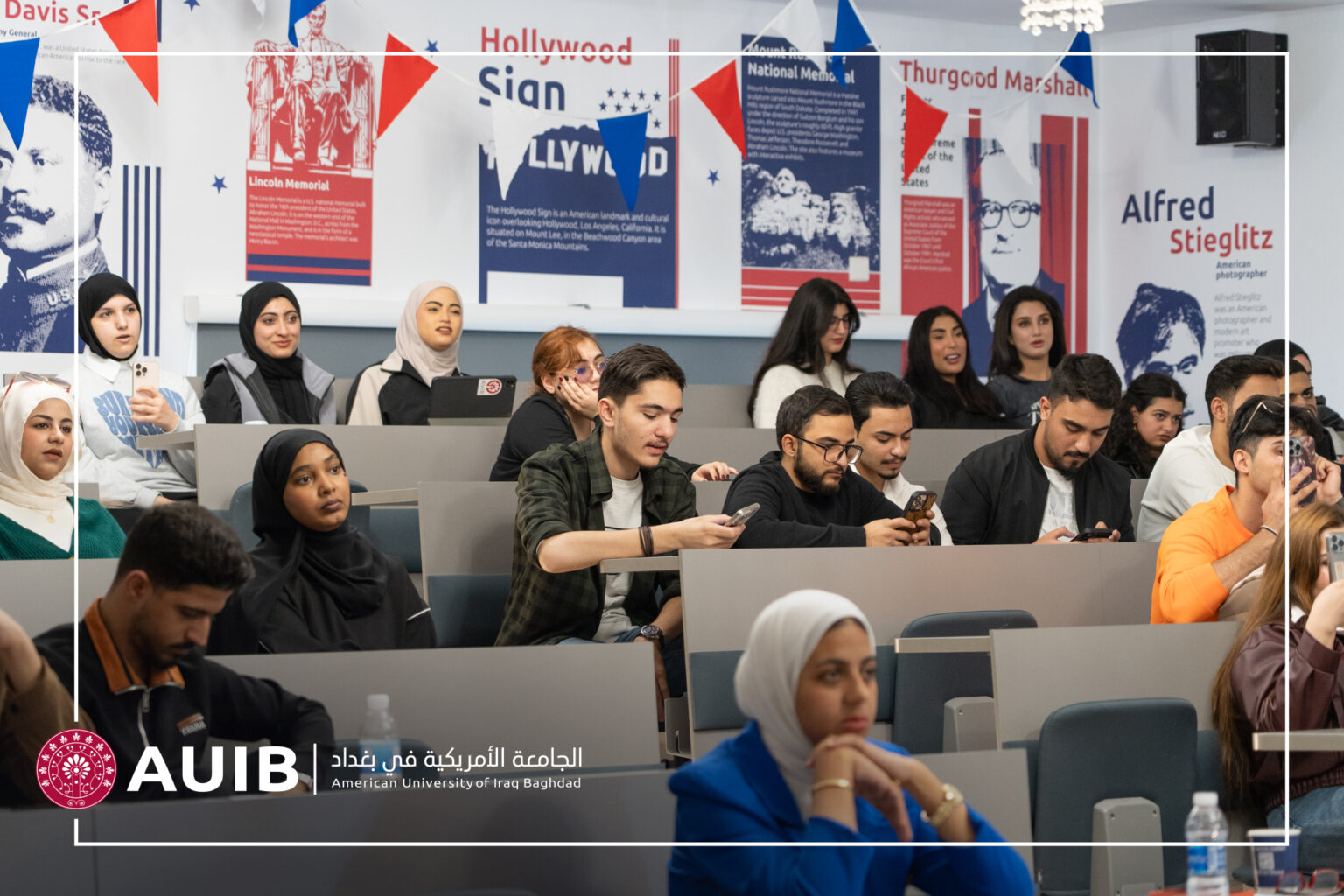
The main hall of the American Space at the American University of Iraq-Baghdad (AUIB) teemed with students during a literary celebration held on the occasion of World Arabic Language Day. It was immediately evident that the students’ keenness to enroll in a university following the American academic model does not in any way signify a desire to abandon their cultural heritage, but rather reflects a commitment to enriching their knowledge, broadening their horizons, and building bridges—not substituting their identity.
Arabic is “a vast ocean,” “the language of holy scripture and art,” and “the language that most intimately speaks to the human soul”; these were some of the descriptions offered by attending students when asked what their mother tongue means to them. The time-honored language is not relegated to old books and museums; it remains a language of communication, science, and function, and even a language for programming in today’s world, as highlighted in a video shown during the event. It is still the language of life for hundreds of millions, and the enthusiastic engagement of the student audience stemmed precisely from the fact that Arabic is a language of life.
The young poet Ali Abdul Karim, an AUIB student, recited some of his verses during the occasion, winning the audience’s applause. Numerous attendees then stepped forward to recite verses from their favorite poems, engaging in friendly competition over their knowledge of classical and contemporary Arabic poetic works. The celebration, with its vibrancy and interactivity, was not merely a cultural event, but an occasion for enjoyment and connection. It provoked reflection on the stature of this venerable language and the charm it still holds, continuing to captivate the hearts of the youth and inspire them.