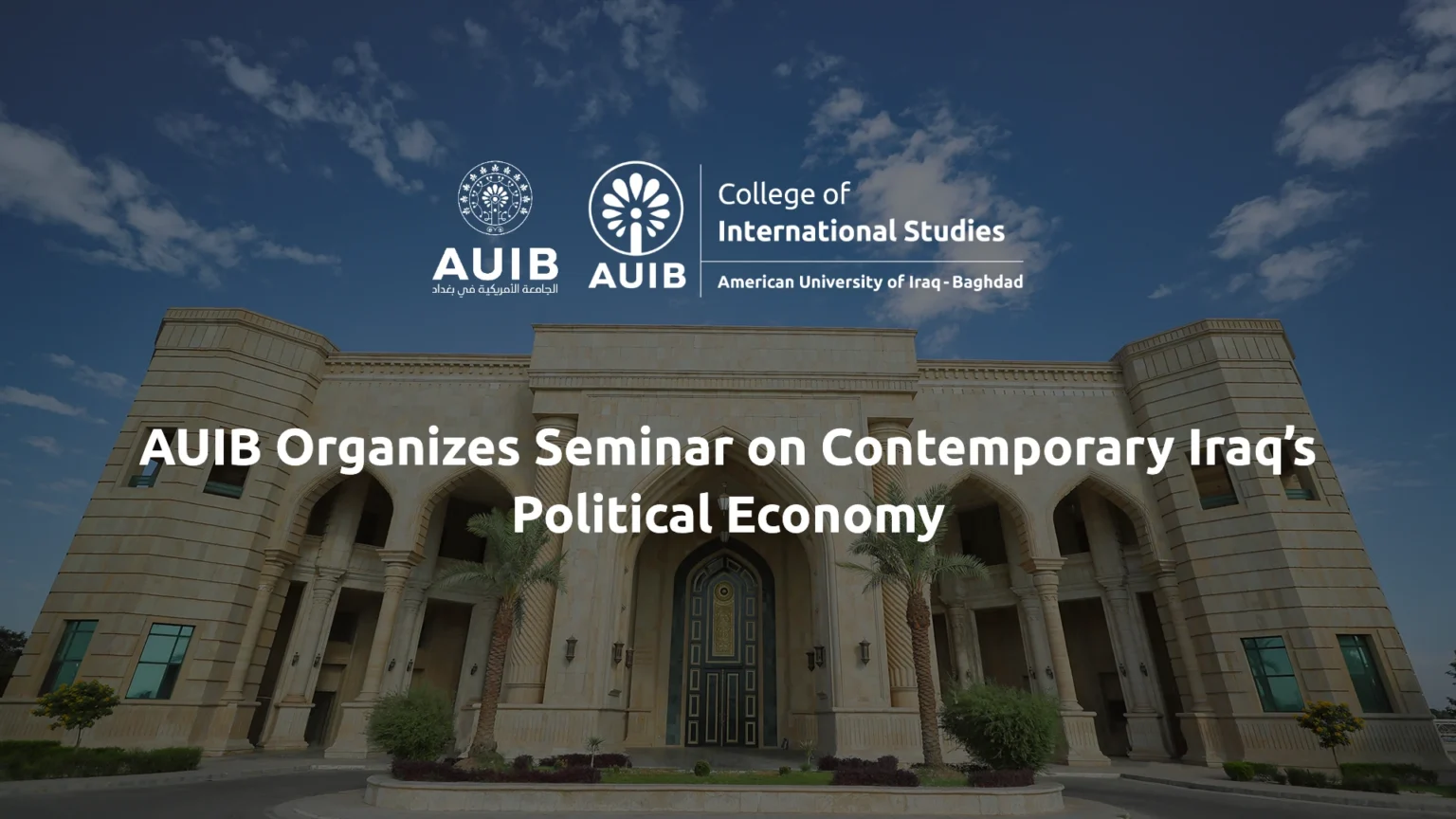
The College of International Studies (CIS) at the American University of Iraq-Baghdad (AUIB), in collaboration with AUIB’s National Heritage Office, organized a seminar titled “The Contemporary State of Iraq’s Political Economy,” where two Chatham House scholars, Dr. Renad Mansour, Senior Research Fellow and Project Director of the Iraq Initiative at Chatham House, and Mr. Hayder Al-Shakeri, gave a talk to an audience of students, faculty, and University officials, followed by a lively discussion of the subject matter.
Dr. Renad Mansour put forth a thought-provoking question: How to define the Iraqi state that arose roughly in the year 2008, after the 2003 U.S. invasion and the ensuing civil war? He objected to “binary” characterizations which he deemed “too simplistic,” namely the “state” or “non-state” dichotomy, making the case that there are two opposing factors, in this regard: “state consolidation amid fragmentation,” where multiple power centers in Iraqi society, both within and outside of the state, vie for political representation and resources, at the same time when Iraq’s oil-dependent, “rentier economy” incentivizes these competing sociopolitical forces “to be inside the system.”
Mr. Al-Shakeri examined the change in state-society relationships across governing regimes, noting what he considered key unchanging features of governance, most notable of which, according to the researcher, are political under-representation, reliance on an oil-dependent, rentier economy, and a lack of societal integration, despite a strong government apparatus.