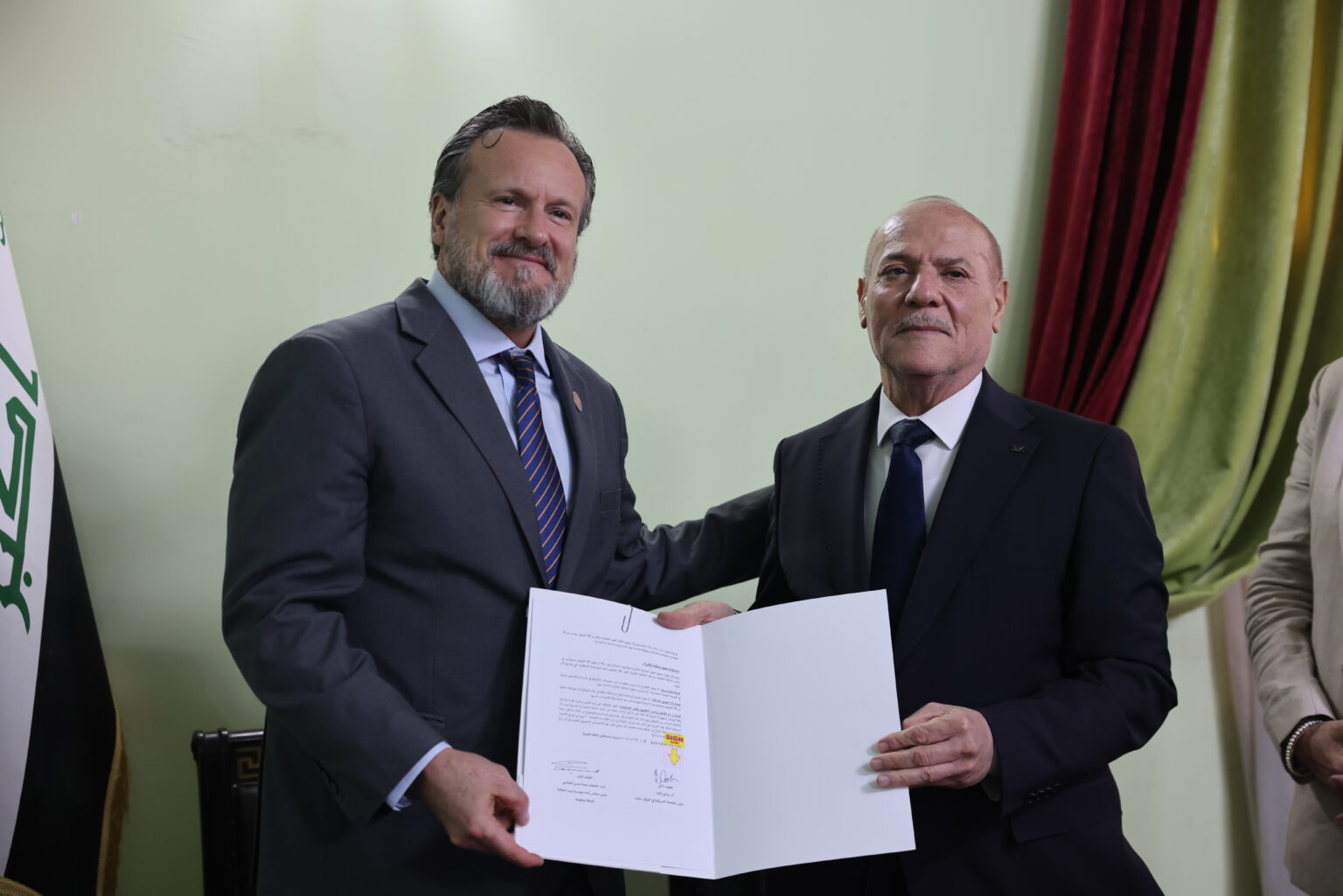
The President of the American University of Iraq – Baghdad (AUIB), Dr. Bradley Cook, signed a scientific cooperation agreement with “Bayt Al-Hikma” institution, represented by the Chairman of its Board of Trustees, Dr. Qahtan Al-Khafaji, at a special ceremony held at the institution’s headquarters in Baghdad.
The agreement allows the university access to the manuscripts, archives, and various historical documents held by the institution and facilitates mutual access to printed and electronic resources in both parties’ libraries. It also enables the shared use of halls and laboratories, establishes a general framework for the exchange of expertise, and fosters cooperation in scientific research, staff training, and development activities for both parties, in addition to organizing seminars, conferences, and workshops.
The signing of the memorandum marks the first step on a path where AUIB and Bayt Al-Hikma will collaborate to establish diverse joint programs aimed at reviving the rich material and intangible cultural heritage of Mesopotamia, mainly, with broader outlooks on global cultural heritage. This initiative aims to allow new generations to draw upon the vast civilizational reservoir of their country and the world as they look toward the future, toward renewal and progress.
“Bayt Al-Hikma” is an intellectual, scientific, and research institution affiliated with the Prime Minister’s Office. Established in 1995, its mission is to study the history of Iraq and the Arab-Islamic civilization, to the benefit of the nation’s present and future. This is achieved by establishing a methodology for dialogue among cultures and religions, and by disseminating a culture of peace and the values of religious tolerance and coexistence among individuals and various social groups. The institution also focuses on monitoring and tracking scientific, political, and economic developments and their future implications for Iraq and the Arab world, as well as conducting studies on citizenship, human rights, fundamental freedoms, and democratic civil values, supporting the processes of decision-making and public policy formulation.