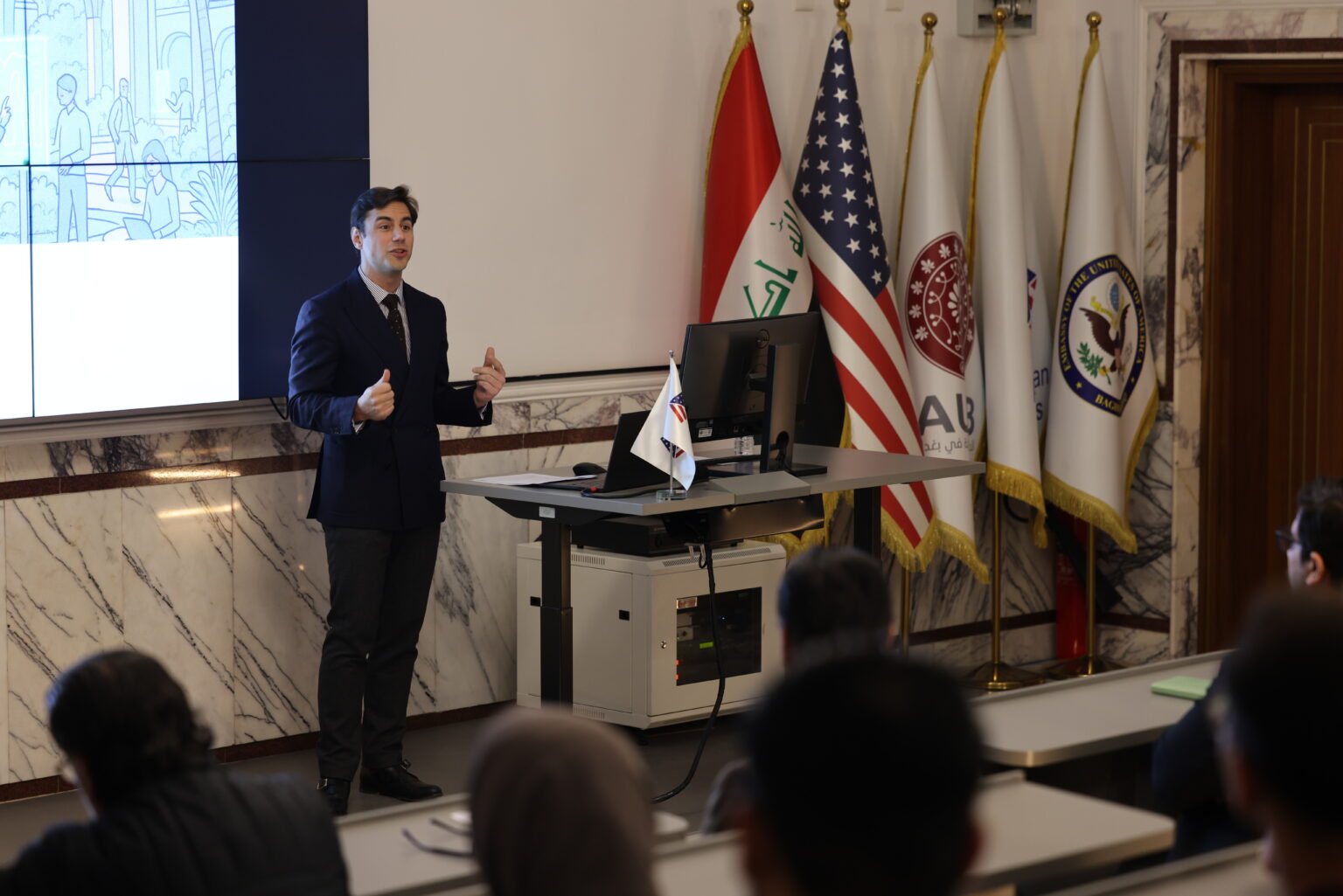
Eager to delve into how Artificial Intelligence is reshaping social interaction and posing existential questions on how societies would evolve over the coming years, students filled AUIB’s American Space auditorium, where the French embassy facilitated an interactive lecture delivered by Dr. Hubert Etienne, researcher in digital and AI Ethics and CEO of Quintessence AI.
In the presence of the Attache for Scientific and Academic Cooperation at the French embassy in Baghdad, Ms. Pauline La Pointe, AUIB members of faculty and staff, and interested parties, Dr. Etienne touched upon a number of themes and issues raised by the nascent AI revolution, provoking thought and perhaps raising more questions to be investigated and contemplated, rather than providing definitive and clear cut answers to such complex and somewhat ambiguous challenges in a new, largely uncharted territory.
The researcher first acknowledged the often-voiced concerns, saying that “the fear of (job) replacement is legitimate for a lot of people” as a result of the proliferating AI-powered automation, as well as the wariness of increased dependence on AI for seeking knowledge, but also decision-making on various levels, which leads in many cases to dysfunction and mental problems. In this regard, he articulated the very real threat to two fundamental and even defining characteristics of human thought and the human condition: “intentionality and human connectedness.”
Dr. Etienne also elaborated on the immense possibilities and new horizons that AI opens up before human civilization, pointing out, at the same time, the grave threats these very possibilities entail. The unprecedented magnitude of information available to increasingly powerful AI models, qualitatively boosted by such arrangements as Generative or Synthetic Dialogue (where two AI platforms, or “Digital Twins”, interact and synthesize information), may bring about sentient entities (Artificial General Intelligence) that could very well surpass human cognition in a manner that would herald in a reality that human society may fail to comprehend, much less manage. An example of this is the possible emergence of “a new species,” the “enhanced humans” (via neurochips or neural links, etc.), and the game-changing sociopolitical and socioeconomic repercussions this would have, posing questions on the legitimacy of individual choices, versus collective social choices, in this regard, as per the researcher.