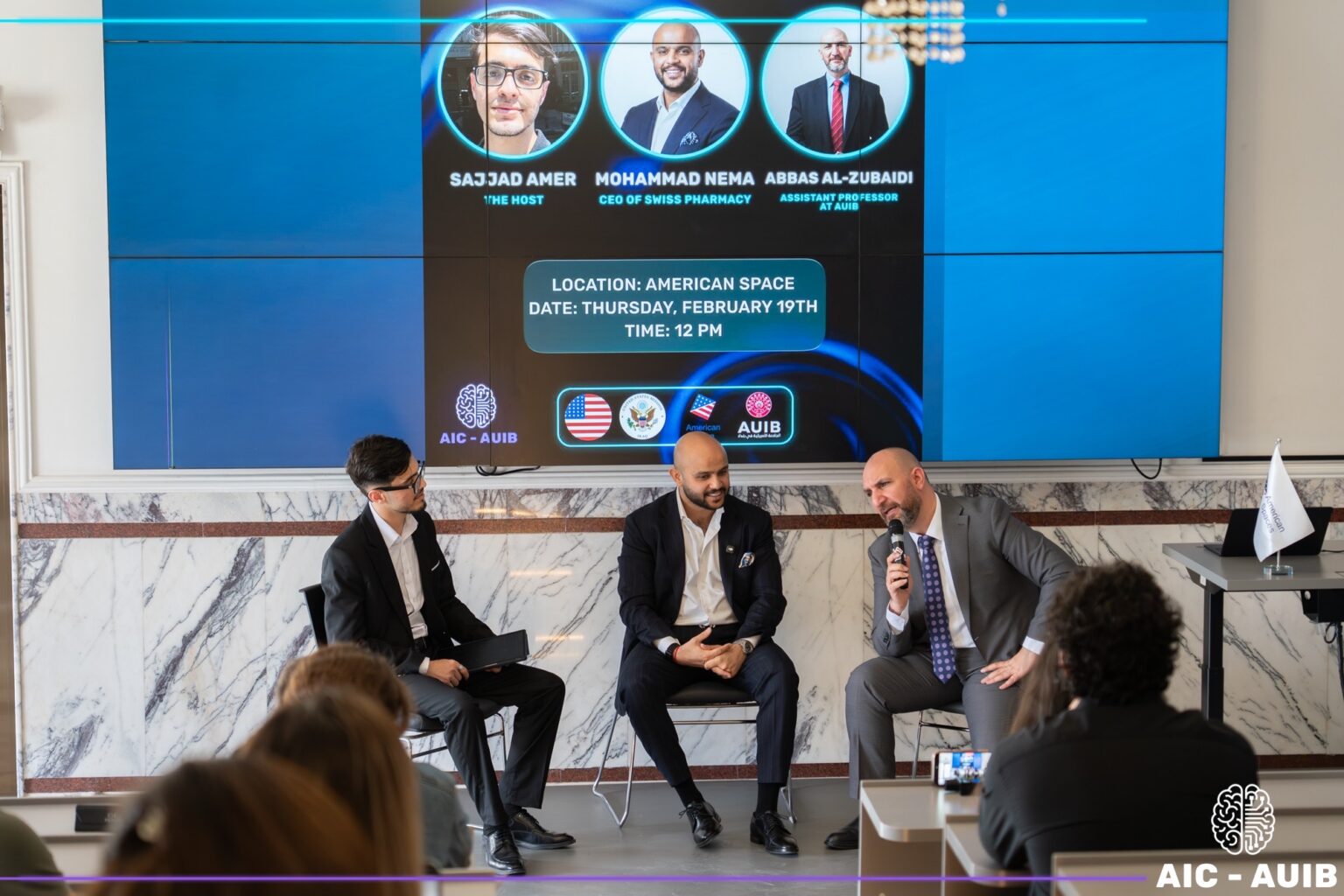
The AI Club at the American University of Iraq-Baghdad (AUIB) organized a discussion panel titled “Will AI Replace Pharmacists?” at AUIB’s American Space, bringing together students, faculty members, and guests to explore the evolving role of Artificial Intelligence in pharmacy practice and the broader healthcare sector.
The panel featured Dr. Abbas Al-Zubaidi, Head of the Department of Radiology at AUIB’s College of Health Sciences, and guest speaker Mr. Mohammad Nema, CEO of Swiss Pharmacy, who both shared valuable insights into how artificial intelligence is transforming healthcare systems and reshaping professional roles within the medical and pharmaceutical fields. The interactive discussion addressed both opportunities and concerns associated with emerging technologies.
While both speakers emphasized that healthcare professions continue to rely heavily on human expertise, ethical judgment, and interpersonal communication, Mr. Nema drew on his experience to showcase how technology and digital systems are increasingly integrated into pharmacy operations to improve efficiency, accuracy, and patient services. Similarly, Dr. Al-Zubaidi elaborated on the growing applications of Artificial Intelligence in radiology and medical research, illustrating how AI supports diagnostic processes and clinical decision-making.
The panelists examined the prospects of future developments in the field, focusing on how AI may enhance patient care through faster analysis, personalized treatment approaches, and improved healthcare accessibility. Rather than replacing pharmacists, AI was presented as a tool that can expand professional opportunities and redefine roles within the healthcare ecosystem.
Addressing students’ concerns regarding career stability in an age of rapid technological shifts, the speakers encouraged students to embrace continuous learning and develop interdisciplinary skills that combine healthcare knowledge with technological literacy, at the same time stressing the importance of human qualities that are perceived to be beyond the capabilities of artificial intelligence, including empathy, trust, (human) communication, and professional judgment—elements that are essential to patient-centered care.