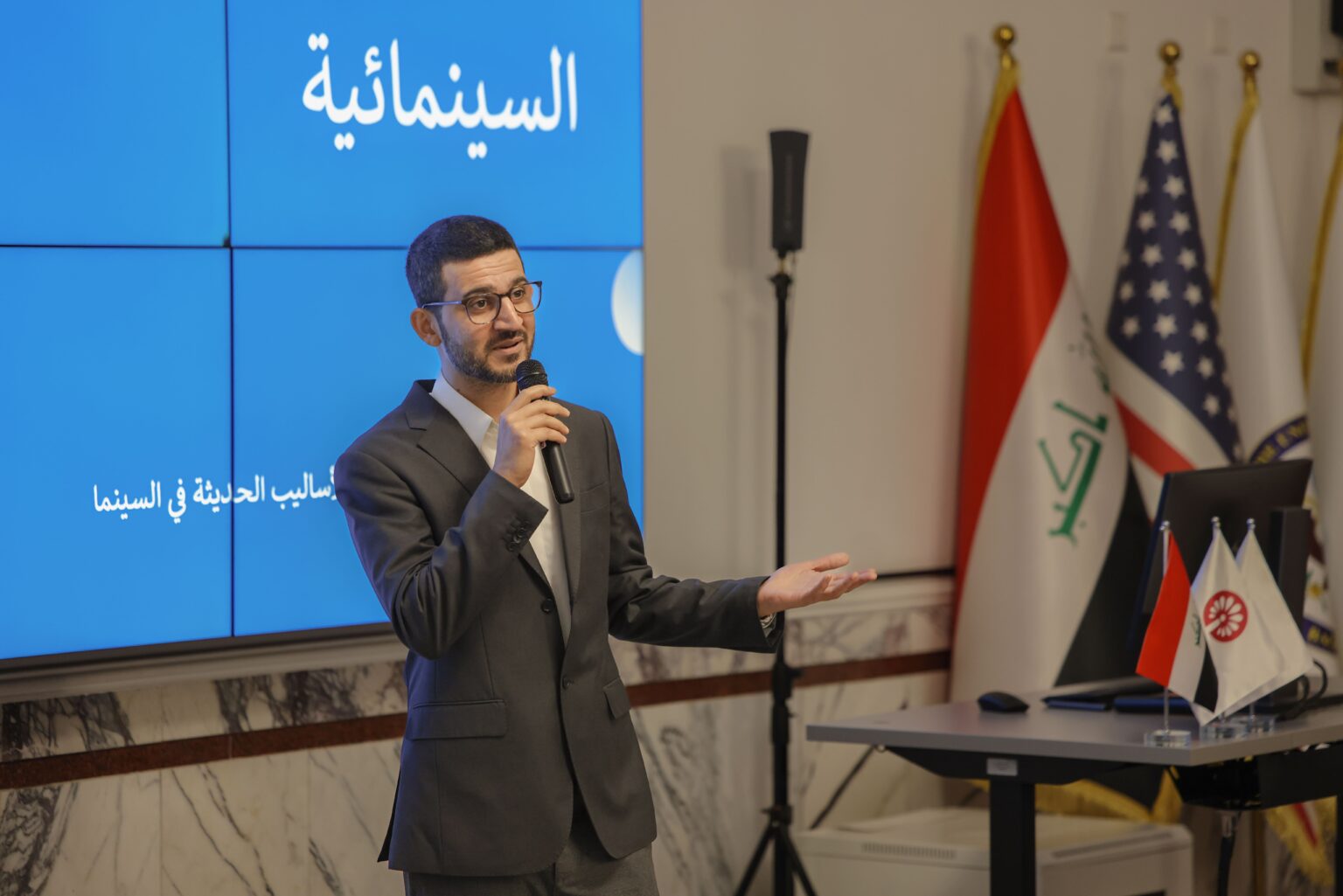
The American Space at the American University of Iraq-Baghdad (AUIB) hosted a workshop on “Artificial Intelligence in the Film Industry,” shedding light on the multifaceted impact of the latest technologies on this industry and those in it. The workshop was led by Iraqi filmmaker Mr. Osama Rasheed, under the auspices of the Austrian embassy in Baghdad, and in the presence of Austrian Ambassador, Mr. Andrea Nasi, AUIB President, Dr. Michael Mulnix, staff members of the Austrian embassy, AUIB faculty and staff members, and an eager crowd of AUIB students.
Cultural Affairs Officer at the Austrian embassy, Ms. Alina Brandstaetter, celebrated “the first cooperation” between her country’s embassy and AUIB, expressing her hope for “many more to come.” She introduced Mr. Osama Rasheed, who lives in Austria and had set up a film production company there.
AI applications in the film industry now allow even those with no advanced technical skills to animate 3D images, said Mr. Osama Rasheed, giving but an example of how deep the impact of emerging technologies is on this industry, only to pose the question: “Did technology kill cinema?” However, the presentation given subsequently by the young Iraqi filmmaker pointed to the opposite of this hypothesis: While digital technology has, over the past two decades, made obsolete numerous processes, techniques, and jobs in filmmaking, statistics shown by Mr. Osama Rasheed demonstrate that the numbers of crew members are increasing, keeping up with the development of this industry (at least as far as the famous, high-budget movies he cited are concerned), and that total movie production has also increased, due to the easing of the process, by virtue of new technological applications that have also afforded wide and easy access to various display platforms, including the personal, serving to promote creativity and release creators from the grip of a handful of production and distribution companies, according to the guest speaker.
Besides the positive aspects of the impact of AI applications on filmmaking, such as supporting, developing, and speeding-up processes such as scriptwriting, videography, and montage, discussion at the workshop also shed light on the negative and dangerous aspects of these dynamics, such as the proliferation of “deepfake” techniques and the malicious manufacturing of audiovisual “reality”.